Advanced Hash Calculator Guide
Advanced Hash Calculator calculates hash values of file contents. Add files to the list, choose a hash algorithm and click Calculate. This guide describes all commands of the program.
Adding Files
- Add Files (toolbar, File > Add Files or Ctrl+O) opens a dialog where you can select one or more files.
- Add Folder (toolbar or File > Add Folder) adds every file of the selected folder and of all its subfolders.
- You can also drag files and folders from Windows Explorer and drop them onto the list.
- Large folders are loaded in the background. The status bar shows the progress; press Ctrl+X to stop loading.
The list has three columns: Files (the full path), Hash and Size. To remove files, select them and click Clear on the toolbar or right-click and choose Remove Item. New List (Ctrl+N) clears the whole list. Ctrl+A selects all files.
Calculating Hashes
Click Calculate on the toolbar (or Action > Calculate Hash, Ctrl+H) to calculate the hash values of all files in the list. To hash only some files, select them, right-click and choose Calculate Hash. Five threads calculate hashes in parallel; the Hash column of each file is updated as soon as its value is ready. Action > Stop (Ctrl+X) cancels the calculation.
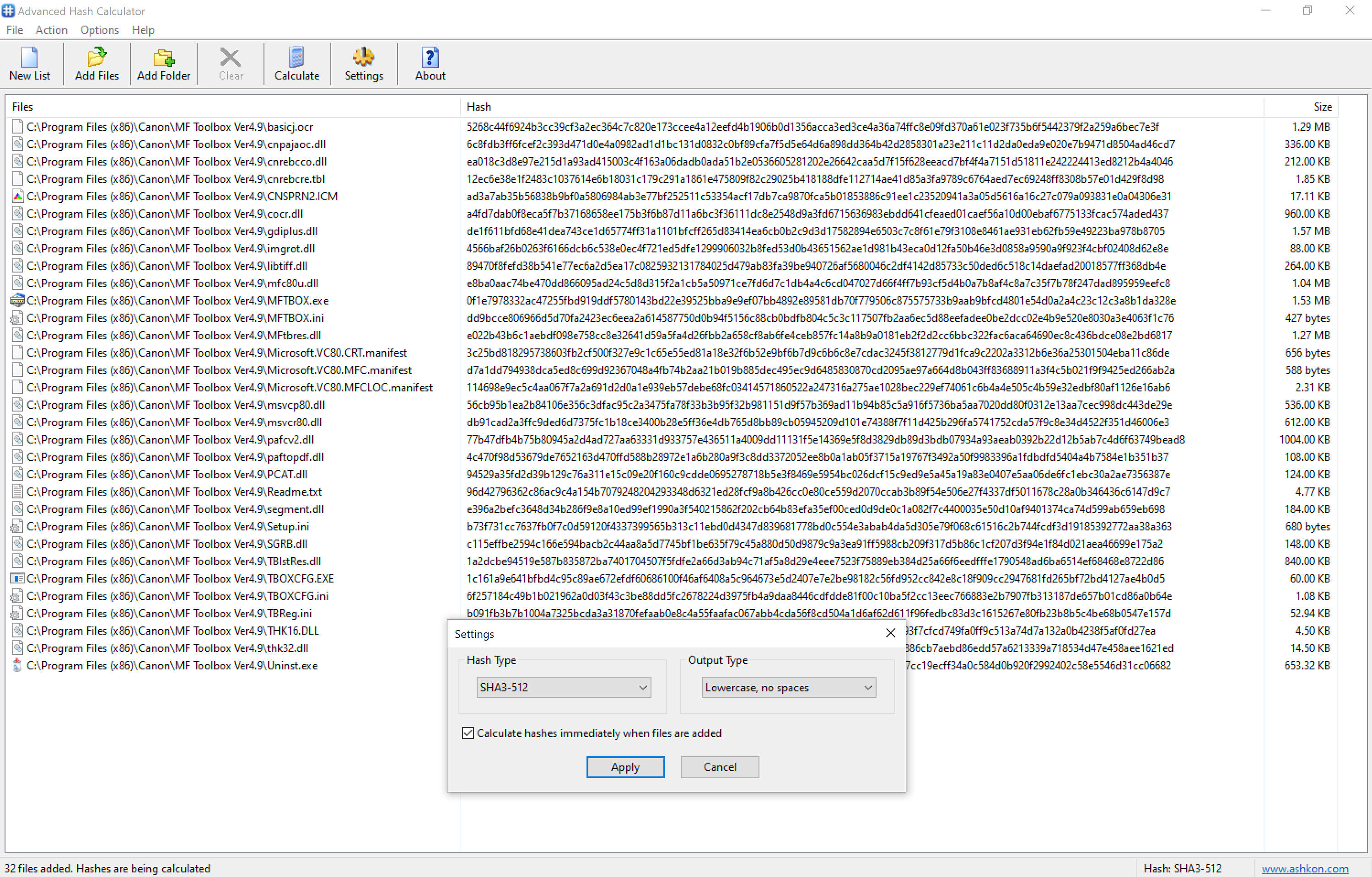
The main window with a list of files hashed with SHA3-512 and the Settings dialog:
Settings
Click Settings on the toolbar or select Options > Settings.
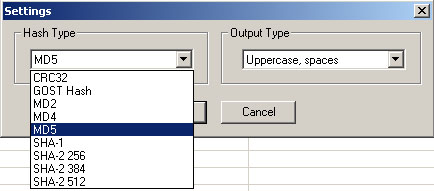
- Hash Type: one of the 32 supported algorithms (CRC32, CRC32C, CRC64, Adler-32, MD2, MD4, MD5, SHA-1, SHA-2, SHA-3, BLAKE2b, BLAKE2s, BLAKE3, xxHash, MurmurHash3, FNV-1a, RIPEMD-160, Tiger, Tiger2, Whirlpool, GOST, Streebog and SM3).
- Output Type: lowercase or uppercase, with or without a space after every two characters.
- Calculate hashes immediately when files are added: when selected, files are hashed as soon as they are added; otherwise hashes are calculated when you click Calculate.
When you change the hash type or the output type, the Hash column is cleared; click Calculate to compute the values with the new settings.
Copying and Exporting Hash Values
Right-click a file in the list to open the context menu:
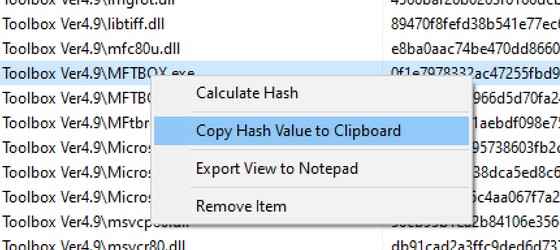
| Calculate Hash | Calculate the hash of the selected files. |
| Copy Hash Value to Clipboard | Copy the hash value of the file to the clipboard. |
| Export View to Notepad | Open a text file with all file names and hash values in Notepad. |
| Remove Item | Remove the selected files from the list. |
Action > Export Data also exports the whole list. Each line of the report has the file path followed by its hash value; the file is saved as UTF-8, so all file names are kept. Double-click a file to open the File Info window, where the full path and the hash can be selected and copied.
Hash Page in the File Properties
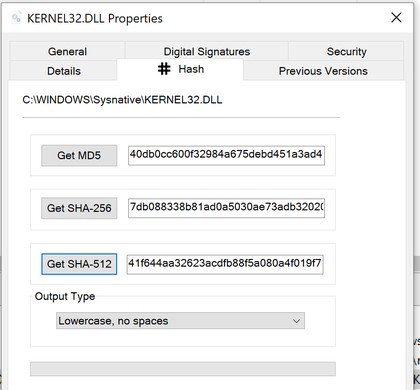
Advanced Hash Calculator includes an optional property page that calculates MD5, SHA-256 and SHA-512 without opening the main program. Right-click a file, select Properties and click the Hash tab. Click Get MD5, Get SHA-256 or Get SHA-512; a progress bar shows the progress for large files, and Output Type selects the format of the result. To install the page, select "Add Hash page to the file Properties dialog" in Setup. For other hash types please use the main program.
System Requirements
Windows 7, 8, 8.1, 10 or 11. The program remembers its window size and position, column widths, hash type and output type between sessions. Uninstalling removes the program, the Hash property page and all its settings.