Advanced DBX Viewer Help
Version 1.0.5.1 for Windows 10/11. This guide explains how to use Advanced DBX Viewer to open, read, search, export and convert the mail of Microsoft Outlook Express 5 and 6 (.dbx files) without Outlook Express.
Contents
- Getting started
- Which files can be opened
- The main window
- Toolbar
- Menu commands
- The message list
- Reading messages
- Attachments
- Saving a message
- Exporting messages and folders
- Converting to Outlook PST
- Saving as PDF
- Exporting the message list to CSV
- Extracting attachments in bulk
- Finding messages
- Address books (.wab)
- Recovering deleted messages
- Damaged .dbx files
- Properties, headers and forensic options
- Keyboard shortcuts
- Troubleshooting
- Registration
1. Getting started
Advanced DBX Viewer requires Windows 10 or Windows 11 and the Microsoft Edge WebView2 Runtime, which is part of Windows 10/11. Outlook Express does not need to be installed.
- Click Open on the toolbar (Ctrl+O).
- Choose Folders.dbx to open the whole store, or any other .dbx file (for example Inbox.dbx) to open just that folder.
- Select a folder in the tree on the left. Its messages appear in the list on the right.
- Click a message to read it in the reading pane, or press Enter to open it in its own window.
The Open dialog starts in the usual location of the Outlook Express store: %LOCALAPPDATA%\Identities\{identity}\Microsoft\Outlook Express. If you copied the store from an old computer or a backup, browse to that folder instead. You can also drag a .dbx file or the whole store folder onto the program window. All files are opened read-only and are never changed.
2. Which files can be opened
| Folders.dbx | The whole store: Local Folders, Inbox, Outbox, Sent Items, Deleted Items, Drafts, your own subfolders, IMAP and newsgroup accounts. |
| A store folder | Drop the folder on the window: it opens through its Folders.dbx. Without one, every .dbx file in the folder becomes a folder in the tree. |
| Any other .dbx | Inbox.dbx, Sent Items.dbx and so on open as a single folder. |
| .wab | An Outlook Express (Windows) address book; see Address books. |
| Offline.dbx, Pop3uidl.dbx | Not opened: these are bookkeeping files of Outlook Express that contain no messages. |
| .mbx / .idx | Not opened: these are Outlook Express 4 files. |
Folder files that are in the store folder but missing from Folders.dbx (left behind by a damaged or rebuilt folder list) are shown under Folders not in Folders.dbx.
Several stores at once. Every File > Open adds another top-level entry to the folder tree, so you can open the stores of several identities or old backups side by side. File > Close (Ctrl+F4) closes the store selected in the tree; File > Close All closes all of them.
3. The main window
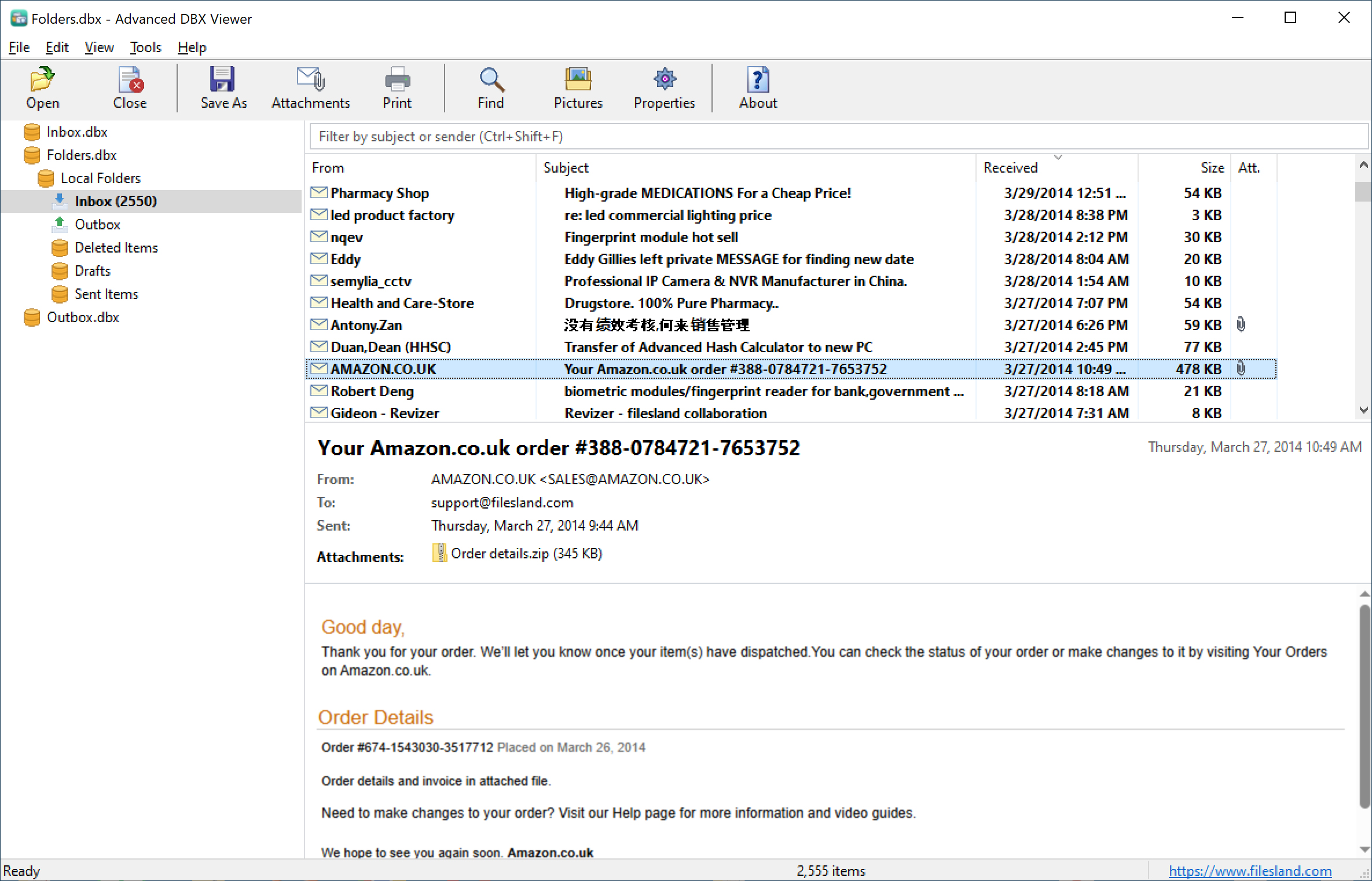
- Folder tree (left). Every open file is a top-level entry. Below it are the folders of the store with special icons for Inbox, Outbox, Sent Items, Deleted Items and Drafts. Folders with unread messages are shown in bold with the unread count, for example Inbox (2550).
- Filter box and message list (top right). One message per row. Unread messages are bold; a paper clip marks messages with attachments.
- Reading pane (bottom right). The subject, date, From, To, Cc and Sent lines, the attachments, and the message text.
- Status bar. Hints for menu commands and toolbar buttons, the number of items in the list, and a link to the FilesLand web site.
Drag the dividers to resize the panes. The window position, the pane sizes, the columns and the sort order are remembered the next time you start the program.
4. Toolbar
| Open | Open an Outlook Express store (Folders.dbx), a folder file (.dbx) or an address book (.wab) (Ctrl+O). |
| Close | Close the store selected in the folder tree (Ctrl+F4). |
| Save As | Save the selected message as EML, HTML, TXT, PDF or MSG (Ctrl+S). |
| Attachments | Save the attachments of the selected message (Ctrl+Shift+S). |
| Print the selected message (Ctrl+P). | |
| Find | Find messages by subject, people, message text or attachment names (Ctrl+E). |
| Pictures | Download pictures and other content from the Internet for HTML messages. |
| Properties | Show the index fields, header fields and MIME structure of the message (Alt+Enter). |
| About | Show the program version and registration information. |
5. Menu commands
File
- Open (Ctrl+O), Close (Ctrl+F4), Close All.
- Save Message As (Ctrl+S): see Saving a message.
- Export Selected Messages (Ctrl+Shift+E) and Export Folder: see Exporting.
- Save Selected as PDF and Export Folder as PDF: see Saving as PDF.
- Export to Outlook PST: see Converting to Outlook PST.
- Export List to CSV: see Exporting the message list.
- Export Contacts: see Address books.
- Save Attachments (Ctrl+Shift+S), Print (Ctrl+P), the recent file list and Exit.
Edit
- Select All (Ctrl+A).
- Find Messages (Ctrl+E), Find in Selected Folder and Quick Filter (Ctrl+Shift+F): see Finding messages.
View
- Toolbar / Status Bar: show or hide these bars.
- Download Pictures from the Internet: always load remote pictures in HTML messages.
- Columns: choose the columns of the message list. Group by Date: group the list by date.
- Open Message in New Window (Enter), Message Properties (Alt+Enter), Internet Headers (Ctrl+H).
Tools
- Extract Attachments: see Extracting attachments in bulk.
- Recover Deleted Messages: see Recovering deleted messages.
- File Information: details, problems found and MD5 / SHA-256 hashes of the open files.
Help
- Online Help (F1): opens this page.
- About Advanced DBX Viewer: version, copyright and registration status.
Right-click menus. Right-click a folder in the tree for Find in This Folder, Export Folder, Export as PDF, Extract Attachments and Close. Right-click messages in the list for Open, Save As, Export Selected Messages, Save as PDF, Export to CSV, Save Attachments, Extract Attachments, Print, Properties, Internet Headers and Select All. Right-click an attachment for Open, Save As and Save All Attachments.
6. The message list
- Columns. Right-click a column header, or use View > Columns, to show or hide From, Subject, Received, Size, Attachment, To, Cc, Sent, Importance, Flag and Categories. Drag a header to change the column order, or drag its edge to change the width.
- Sort. Click a column header to sort by that column; click it again to reverse the order.
- Group by Date. View > Group by Date groups the messages under Today, Yesterday, Earlier This Week, Last Week, Earlier This Month, Last Month and Older.
- Selecting. Use Ctrl+click and Shift+click to select several messages, or Ctrl+A to select all. Most commands work on all selected messages.
- Large folders are loaded in the background: the first messages appear immediately and the rest are added while you work.
7. Reading messages
HTML messages are shown by Microsoft Edge WebView2 with their inline pictures, exactly as the sender designed them. Plain text messages are shown with clickable links. Text in any character set is decoded correctly. Newsgroup articles show their newsgroups line.
- Privacy. Scripts in messages never run. Pictures and other content from the Internet (including tracking pixels) are blocked. To load them for one message, click Download pictures in the yellow bar or the Pictures toolbar button. To always load them, turn on View > Download Pictures from the Internet.
- Links open in your default web browser. Hold the mouse over a link to see its real target.
- Message windows. Press Enter or double-click a message to open it in its own window. Attached messages open in their own window too. Press Esc to close a message window.
- Printing (Ctrl+P) prints the message with a header block: subject, from, sent, to, cc and the names of the attachments.
- If a message was found by recovery or salvage, the reading pane says so.
8. Attachments
Attachments are listed in the reading pane under the header. Double-click an attachment to open it, or right-click it for Open, Save As and Save All Attachments. An attachment is opened from a temporary read-only copy; for executable and other risky file types you are warned first. File > Save Attachments (Ctrl+Shift+S) saves all attachments of the selected message to a folder. To save the attachments of many messages, see Extracting attachments in bulk.
9. Saving a message
Select a message and choose File > Save Message As (Ctrl+S). Choose the format in the Save as type box:
| E-mail (.eml) | The original message as stored in the .dbx file, with all attachments. Opens in Outlook, Thunderbird and Windows Mail. |
| Web page (.html) | One file with the header, the message text and its pictures embedded. |
| Text (.txt) | Header lines and the plain text of the message. |
| PDF (.pdf) | The message as it looks in the reading pane, with a header block. |
| Outlook message (.msg) | An Outlook item with recipients and attachments. Opens in Outlook. |
10. Exporting messages and folders
To save many messages at once, select them and choose File > Export Selected Messages (Ctrl+Shift+E), or select a folder and choose File > Export Folder. In the Export window:
- Format: E-mail messages (.eml), Web pages (.html), Text files (.txt) and PDF documents (.pdf) create one file per message; MBOX mailbox (.mbox) creates one file per folder for Thunderbird and Apple Mail; Outlook messages (.msg) create one Outlook item per message; Outlook personal folders (.pst) creates a single file with the whole folder tree (see Converting to Outlook PST). A short description of the selected format is shown in the window.
- Save in: the destination folder. Click Browse to choose it.
- File names: a pattern for the names of the exported files. Click in the box and use the
tokens
{date} {time} {subject} {from} {to} {folder} {type} {index} {id} {year} {month} {day}, for example{date}_{from}_{subject}. Characters that are not allowed in file names are replaced, long names are shortened to stay within the Windows path limit, and duplicates are numbered. An example of the resulting name is shown below the box. - Include subfolders: also export all subfolders of the folder.
- Recreate the folder structure: create a folder on disk for every folder of the store.
- File dates from the messages: the exported files get the dates of the message (created = sent, modified = received).
- Forensic manifest and log: see Forensic options.
Click Export. A progress window shows how far the export is; click Cancel to stop it. The program stays responsive while an export runs.
11. Converting to Outlook PST
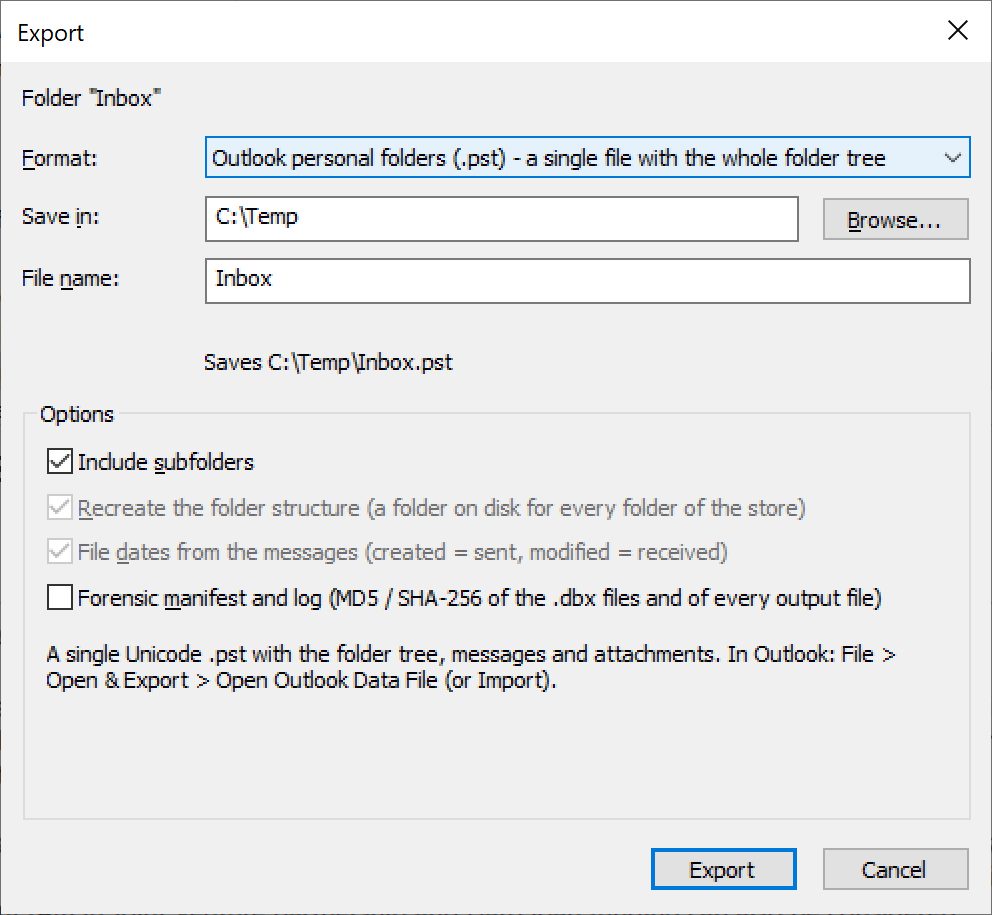
Advanced DBX Viewer can convert your Outlook Express mail into a single Unicode Outlook data file (.pst). Outlook does not need to be installed on the computer that runs the conversion.
- Select the folder to convert in the tree. To convert the whole store, select its top-level entry.
- Choose File > Export to Outlook PST (or Export Folder and the format Outlook personal folders (.pst)).
- Choose the destination folder in Save in and type the File name of the .pst file. The full path is shown below, for example Saves C:\Temp\Inbox.pst.
- Keep Include subfolders checked to convert all subfolders as well, and click Export.
The .pst file contains the folder tree, all messages and their attachments. In Outlook choose File > Open & Export > Open Outlook Data File to open it, or Import/Export to copy the messages into your mailbox. The same file can be imported into Microsoft 365.
12. Saving as PDF
File > Save Selected as PDF saves each selected message as a PDF file. File > Export Folder as PDF does the same for every message of the selected folder and its subfolders. PDF files are created with Microsoft Edge WebView2 and look like the message in the reading pane, with a header block at the top. Pictures from the Internet are included only when View > Download Pictures from the Internet is on. The progress window has a Cancel button.
13. Exporting the message list to CSV
File > Export List to CSV saves the messages in the list (or only the selected messages) as a CSV file for Excel and other spreadsheet programs, for reports and eDiscovery. The file is UTF-8 and contains the folder, subject, sender, To, Cc, Bcc, sent and received dates (UTC), size, importance, read status, flag, categories, number and names of attachments, Message-ID, and the origin, source file and file offset of every message.
14. Extracting attachments in bulk
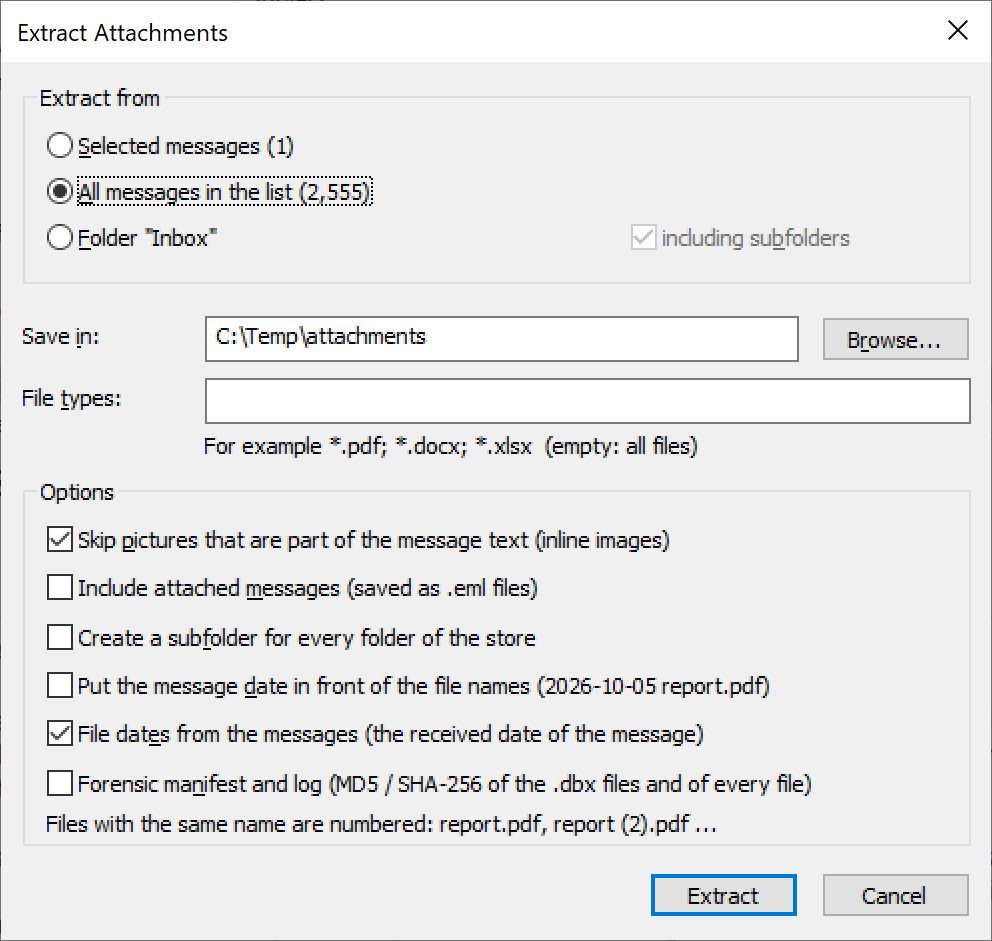
Choose Tools > Extract Attachments to save the attachments of many messages at once.
- Extract from: the selected messages, all messages in the list, or the selected folder (optionally including its subfolders). The number of messages is shown next to each choice.
- Save in: the destination folder.
- File types: for example
*.pdf; *.docx; *.xlsx. Leave the box empty to save all files. - Skip pictures that are part of the message text: do not save inline images such as logos and signatures.
- Include attached messages: save attached e-mails as .eml files.
- Create a subfolder for every folder of the store.
- Put the message date in front of the file names, for example 2026-10-05 report.pdf.
- File dates from the messages: the saved files get the received date of their message.
- Forensic manifest and log: see Forensic options.
Files with the same name are numbered: report.pdf, report (2).pdf and so on.
15. Finding messages
Quick filter. Type in the Filter box above the message list (Ctrl+Shift+F) to show only messages whose subject or sender contains the text. Clear the box to show all messages again.
Find Messages (Ctrl+E, or the Find toolbar button) searches more thoroughly:
- Find messages that contain: the text to look for, with Match case and Whole words only.
- Look in: Subject, People (sender and recipients, sender only, or recipients only), Message text (slower) and Attachment names.
- Search: all open files, all folders of the selected file, or the selected folder and its subfolders (Edit > Find in Selected Folder starts with this choice).
- More conditions: a date range, only messages with attachments, and a size range in KB.
The results are listed with the folder of every message; when several files are open, the folder starts with the name of the file it comes from. Search hits are highlighted in the message text, the subject, the From / To / Cc lines and the attachment names. The results can be exported, saved as PDF or used for attachment extraction like any other list.
16. Address books (.wab)
Outlook Express keeps contacts in a Windows Address Book file (.wab), usually in %APPDATA%\Microsoft\Address Book. Open it with File > Open, or copy it next to the .dbx files: it is then found automatically. A Contacts entry appears in the folder tree.
- The list shows contacts and groups with name, e-mail address, company and phone numbers. The reading pane shows every field of the selected contact.
- Deleted contacts and contacts missing from the address book index are found by scanning the file and are shown in gray.
- File > Export Contacts (or right-click the list) exports all or the selected contacts to a CSV file with Outlook's column names, to one vCard file, or to one vCard file per contact.
17. Recovering deleted messages
When you delete a message in Outlook Express (or empty Deleted Items), the message text stays in the .dbx file until the folder is compacted. Tools > Recover Deleted Messages scans every file of the store for such messages, and for messages that are in a file but not in its index. They are listed in a Recovered Items folder, where you can read, search, save and export them like any other message. The scan can be cancelled. Messages that were removed by compacting cannot be recovered.
18. Damaged .dbx files
Advanced DBX Viewer reads damaged files without ever writing to them:
- A folder file with a damaged header or index, or one that was cut off (for example at the 2 GB limit of Outlook Express, or by a copy error): its messages are collected from the whole file and listed as salvaged messages. The last message of a cut-off file keeps the part that is there.
- A damaged Folders.dbx: the folder tree is rebuilt from the folder records found in the file.
- Damaged .dbx files that are not in Folders.dbx are salvaged as well.
Tools > File Information lists every problem found.
19. Properties, headers and forensic options
- Internet Headers (Ctrl+H): the original header lines of the message (Received, Return-Path, Message-ID ...). Click Copy to copy them to the clipboard.
- Message Properties (Alt+Enter): the index fields of the .dbx file, every header field (decoded, and as stored), the MIME structure of the message (double-click a part to see its header and content), the origin of the message (indexed, salvaged, recovered or attached) and its file offsets.
- File Information: the open files with their size, dates, problems found, and MD5 and SHA-256 hashes. The hashes are computed in the background with a progress bar.
- Forensic manifest and log (option in Export and Extract Attachments): writes Export <date> manifest.csv with one line per message or attachment (origin, source file, file offset, message index, Message-ID, dates, output file and its MD5 / SHA-256), and Export <date> log.txt with the user, computer, times, options and the size, time and hashes of the source files.
- File dates from the messages: exported files get created = sent and modified = received.
20. Keyboard shortcuts
| Ctrl+O | Open a file |
| Ctrl+F4 | Close the selected store |
| Ctrl+S | Save the message as ... |
| Ctrl+Shift+S | Save the attachments of the message |
| Ctrl+Shift+E | Export the selected messages |
| Ctrl+P | Print the message |
| Ctrl+E | Find messages |
| Ctrl+Shift+F | Go to the Filter box |
| Ctrl+A | Select all messages |
| Enter | Open the message in a new window |
| Alt+Enter | Message properties |
| Ctrl+H | Internet headers |
| Esc | Close a message window |
| F1 | Online help |
21. Troubleshooting
- I can't find my .dbx files. In Windows Explorer, type %LOCALAPPDATA%\Identities in the address bar and open {identity}\Microsoft\Outlook Express. On Windows XP the folder was C:\Documents and Settings\<user>\Local Settings\Application Data\Identities. In Outlook Express itself, Tools > Options > Maintenance > Store Folder shows the location.
- Offline.dbx or Pop3uidl.dbx can't be opened. These files contain no messages. Open Folders.dbx or a folder file such as Inbox.dbx.
- A folder is missing from the tree. Open the store folder by dropping it on the window; files that are not listed in Folders.dbx appear under Folders not in Folders.dbx.
- A message I deleted is not there. Run Tools > Recover Deleted Messages. If Outlook Express compacted the folder after the message was deleted, it is gone.
- Pictures are missing in an HTML message. Pictures from the Internet are blocked for your privacy. Click Download pictures in the yellow bar.
- Messages are shown as plain text only. The Microsoft Edge WebView2 Runtime is missing. It is part of Windows 10/11; it can also be downloaded from Microsoft.
- Outlook says the .pst file can't be opened. Make sure the export finished (it was not cancelled), and that the file is not on a read-only or network drive that Outlook can't write to.
- Files from Outlook 2000-2019/365 (.pst, .ost). Use Advanced PST Viewer. For Thunderbird, Apple Mail and Gmail (MBOX) use Advanced MBOX Viewer.
22. Registration
The unregistered version is fully functional for a 30-day evaluation period. The startup window shows which day of the evaluation you are on. Click Continue to keep evaluating or Quit to exit. When the 30 days are over, the program shows an expiration message and opens the registration page.
To register, click Register in the startup window (the program closes and opens the registration page in your web browser). The About window shows who the copy is registered to.