
Advanced MBOX Viewer
Advanced MBOX Viewer opens MBOX mailboxes — Mozilla Thunderbird folders and profiles, Apple Mail exports, Google Takeout (Gmail) archives and the .mbox / .mbx files of Eudora, SeaMonkey, Unix mail and many other programs — without the program that created them. Browse the folders, read e-mail messages exactly as they were sent, open and save attachments, search, and export messages to EML, HTML, PDF, MBOX or an Outlook PST file — all from one small program that needs no mail program, no mail account and no import.
HTML messages are displayed by Microsoft Edge WebView2, the same modern engine used by Microsoft Edge, so newsletters, signatures, tables and inline pictures look the way the sender designed them. Multi-gigabyte mailboxes are indexed in seconds. Built-in tools convert mailboxes to Outlook PST, save many messages as one PDF with page or Bates numbers, merge and split MBOX files, remove duplicates and extract e-mail addresses. Your mail files are opened read-only and are never modified.
Size: 3.16 MB
Released: October 2026
Price: $49.95
Operating Systems: Windows 10/11
Supported Files: MBOX files (.mbox, .mbx, .mbs), Thunderbird folder files and profiles, Apple Mail .mbox packages, Google Takeout (Gmail) .mbox archives
Requires: Microsoft Edge WebView2 Runtime (preinstalled on Windows 10/11). Thunderbird, Apple Mail or Outlook are not required.


Supported Features
Opening MBOX mailboxes
- Single MBOX files: .mbox, .mbx, .mbs and Thunderbird folder files without an extension (Inbox, Sent ...); Thunderbird subfolders (.sbd) are shown below their folder.
- Whole folders (File > Open Folder or drag and drop): a Thunderbird profile, Local Folders, IMAP account folders or any folder of exported .mbox files, with all subfolders.
- Apple Mail .mbox packages, including nested mailboxes.
- Google Takeout (Gmail): the labels of "All mail Including Spam and Trash.mbox" become folders (Inbox, Sent, your own and nested labels), with the read and starred state of every message.
- Works without Thunderbird, Apple Mail or Gmail — no accounts, no profiles, no import.
- Several mailboxes at once: every File > Open adds another mailbox to the folder tree.
- Read-only, shared access: your mail files are never modified and can stay open in Thunderbird.
- Open files from the File menu, by drag and drop, from the command line, from the recent file list or with "Open with" in Windows Explorer.
- Very large files: gigabyte mailboxes are indexed in seconds; message text is read from the file only when it is shown.
- Full Unicode support for file names, folder names and message text in any language.
- Familiar three-pane layout: folder tree with unread counts and special folder icons, message list and reading pane.
- Double-click a message to open it in its own window; attached messages open in their own window as well.
- Window position, splitters, column widths and sort order are remembered.
Accurate message display
- HTML messages rendered by Microsoft Edge WebView2, with inline images.
- Plain text messages with clickable links; format=flowed text and uuencoded attachments are supported.
- Messages in any character set; signed messages (S/MIME, PGP/MIME) show their text.
- Privacy protection: scripts never run, links open in your default browser, and pictures from the Internet (including tracking pixels) are downloaded only when you allow it.
- The real target of a link is shown on hover.
- Print messages with a header block (subject, from, sent, to, cc, attachments).
Convert to Outlook PST
- Export to Outlook PST: convert Thunderbird, Gmail (Google Takeout) and Apple Mail mailboxes to one Unicode Outlook data file for Outlook and Microsoft 365 — Outlook does not need to be installed.
- Folders, sender and recipients, dates, read / replied / forwarded / flagged state, categories, HTML and plain text, Internet headers and attachments are kept.
- Export the selected messages, a folder or a folder with all its subfolders.
Save and export
- Save a message as EML (the original message — opens in Outlook, Thunderbird, Windows Mail), single-file HTML with embedded images, plain text or PDF.
- Export selected messages, a folder, or a folder with all its subfolders to EML, HTML, TXT, PDF, MBOX or Outlook PST.
- One PDF for many messages, each message on a new page, with page numbers ("Page 1 of 12") or Bates numbers — for legal, HR and insurance evidence.
- Split large MBOX files by size, year or month, or write all folders to one mailbox file.
- Skip duplicate messages (same Message-ID, or the same text when there is none).
- Recreate the folder structure on disk.
- File name patterns such as
{date}_{from}_{subject}(tokens: date, time, subject, from, to, folder, type, index, id, year, month, day); long names are shortened automatically and duplicates are numbered. - Export the message list to CSV (Excel) for reports and eDiscovery.
Mailbox tools
- Merge MBOX files: combine any number of MBOX files and folders into one MBOX file, with duplicates removed and optionally sorted by date.
- Extract e-mail addresses from From / Sender, To, Cc, Bcc and Reply-To: every address once with its most used name, message counts and first / last date; save as CSV (Excel, Outlook and Gmail import) or vCard. Automated senders (no-reply, mailer-daemon) can be skipped.
- Extract attachments in bulk from the selected messages, the whole message list or a folder with all its subfolders, filtered by file type, with inline pictures skipped and date prefixes added on request.
Search and organize
- Find messages by subject, people (sender and recipients, sender only or recipients only), message text or attachment names, in all folders or in a selected folder and its subfolders.
- Search options: match case, whole words, date range, "with attachments" and message size range; the results show the folder of each message.
- Search hits are highlighted in the message body, subject, From / To / Cc lines and attachment names.
- Quick filter box above the message list (Ctrl+Shift+F) filters by subject or sender as you type.
- Column chooser: From, Subject, Received, Size, Attachment, To, Cc, Sent, Importance, Flag, Categories, MD5 and SHA-256 — drag to reorder; your choice is remembered.
- Sort by any column and group by date (Today, Yesterday, Earlier This Week, Last Week, Earlier This Month, Last Month, Older).
Recovery and forensics
- Recover deleted messages that Thunderbird has not yet compacted away, and message text in damaged files.
- MD5 and SHA-256 hash of every message, in the message list, the Properties window and the CSV export. The hash does not change between MBOX files and exports.
- Export log and chain-of-custody report: one row per message with source and output hashes and Bates range, plus a report with the user, computer, time, options and file hashes.
- Internet headers of a message.
- Message properties: file, offset and length of the message in the MBOX file, its separator line, X-Mozilla-Status, Status and Gmail labels, every header field and the MIME structure.
- File information about the open mailbox.
Main Window
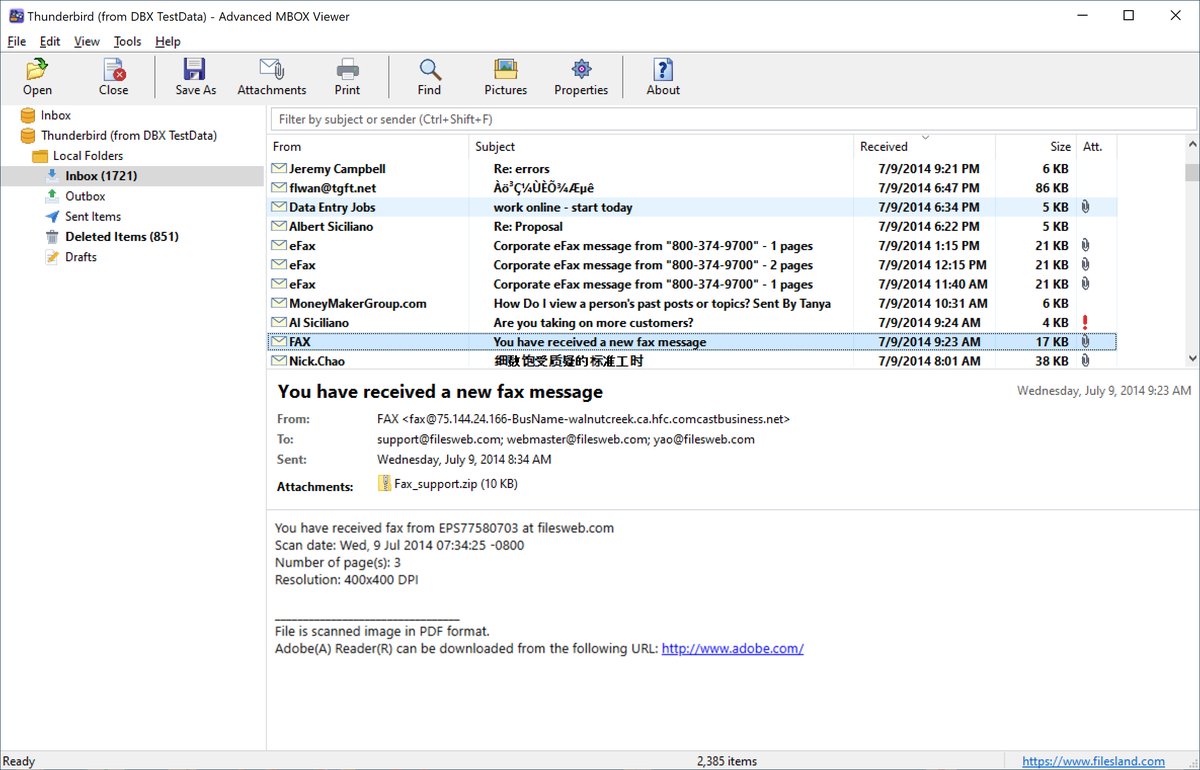
The folder tree of the mailbox is on the left, the message list with the quick filter box is on the top right, and the selected message is shown in the reading pane below it.
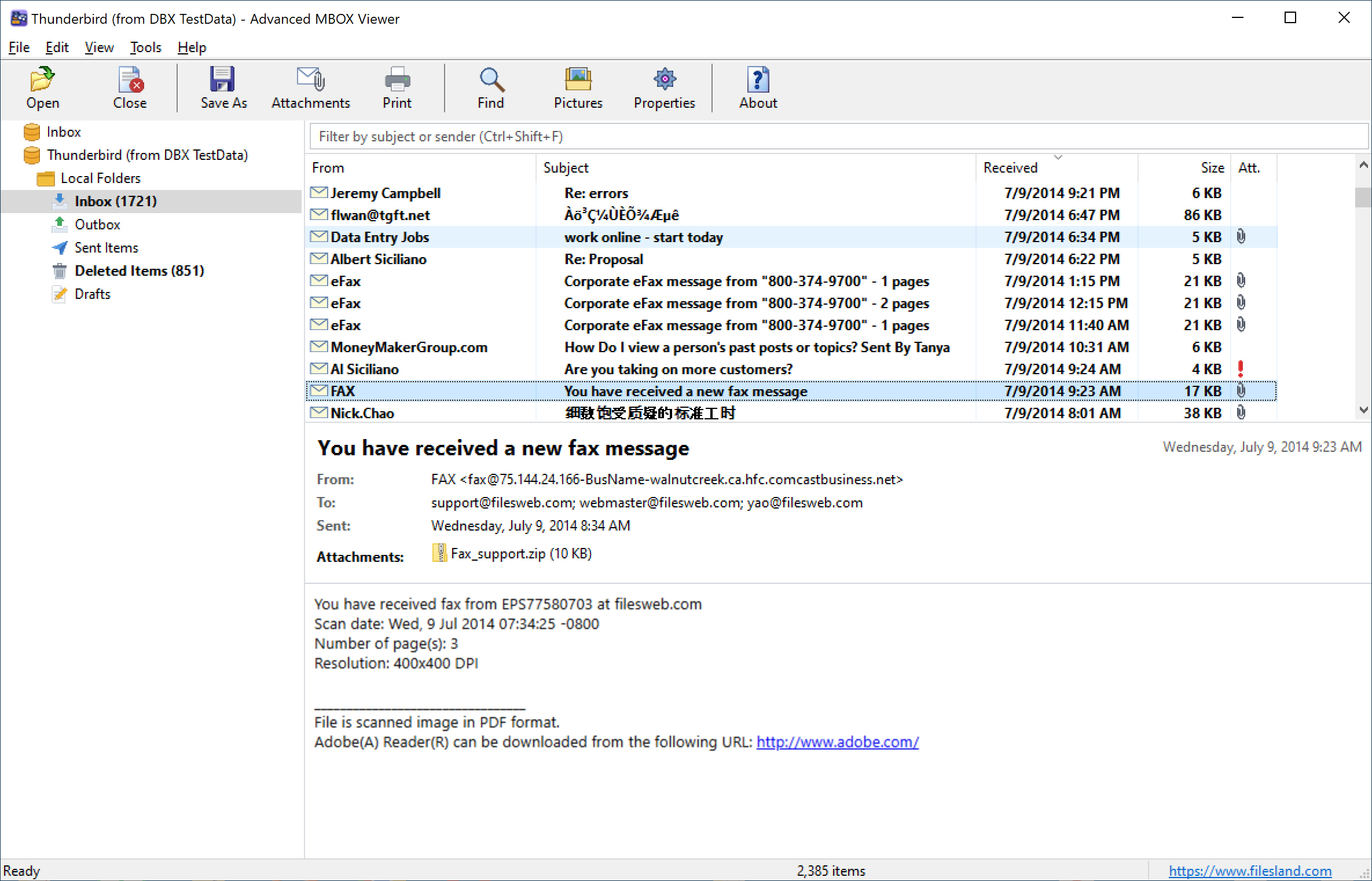
Convert MBOX to Outlook PST
Select a folder, choose File > Export Folder to Outlook PST, pick the destination folder and the data file name, and click Export. Open the new file in Outlook with File > Open > Open Outlook Data File, or import it into Microsoft 365.
Getting Started
Click "Open" on the toolbar (Ctrl+O) and choose an MBOX file, or use File > Open Folder (Ctrl+Shift+O) to open a Thunderbird profile, Local Folders or a folder of exported mailboxes. You can also drag files and folders onto the program window. Select a folder in the tree on the left to list its messages, then click a message to read it in the reading pane. Press Enter or double-click to open the message in its own window.
These are the most frequently used commands. You can run them from the toolbar:
| Open | Open an MBOX file (.mbox, Thunderbird folder file, Google Takeout, Apple Mail mbox). |
| Close | Close the mailbox selected in the folder tree. |
| Save As | Save the selected message as EML, HTML, TXT or PDF. |
| Attachments | Save the attachments of the selected message. |
| Print the selected message. | |
| Find | Search messages by subject, people, message text or attachment names. |
| Pictures | Download pictures from the Internet for HTML messages (blocked by default). |
| Properties | Show the mailbox fields, header fields and MIME structure of the selected message. |
| About | Show the program version and registration information. |
The complete user guide — exporting, converting to PST, PDF with Bates numbers, merging and splitting mailboxes, extracting addresses and attachments, search, recovery and forensic options — is in the Advanced MBOX Viewer Help.