
Advanced PST Viewer
Advanced PST Viewer opens Microsoft Outlook data files (.pst and .ost) without Outlook. Browse the folders of the file, read e-mail messages exactly as they were sent, open and save attachments, search, and export messages, contacts and calendar items — all from a single small program that needs no Outlook, no Exchange account and no MAPI installation.
HTML messages are displayed by Microsoft Edge WebView2, the same modern engine used by Microsoft Edge, so newsletters, signatures, tables and inline pictures look the way the sender designed them. Messages stored as RTF are converted, and HTML hidden inside RTF bodies is restored. Password-protected PST files open seamlessly, without asking for the password. Your data files are opened read-only and are never modified.
Size: 2.96 MB
Released: October 2026
Price: $49.95
Operating Systems: Windows 10/11
Supported Files: Outlook .pst and .ost (ANSI and Unicode, all Outlook versions from Outlook 97 to Microsoft 365)
Requires: Microsoft Edge WebView2 Runtime (preinstalled on Windows 10/11). Outlook is not required.


Supported Features
Opening and reading Outlook data files
- PST and OST files of all Outlook versions: ANSI (Outlook 97–2002), Unicode (Outlook 2003 and later) and OST files of Outlook 2013 and later (4 KB pages, compressed blocks).
- Opens password-protected PST files seamlessly — no password prompt, no password needed; files protected with an Outlook PST password open like any other file.
- Works without Outlook — no MAPI, no Exchange account, no Outlook profiles.
- Read-only, shared access: your data files are never modified, and a file can stay open in Outlook.
- Open files from the File menu, by drag and drop, from the command line, from the recent file list or with "Open with" in Windows Explorer.
- Large files: messages appear immediately while big folders are still loading in the background.
- Full Unicode support for file names, folder names and message text in any language; per-message code pages for ANSI PST files.
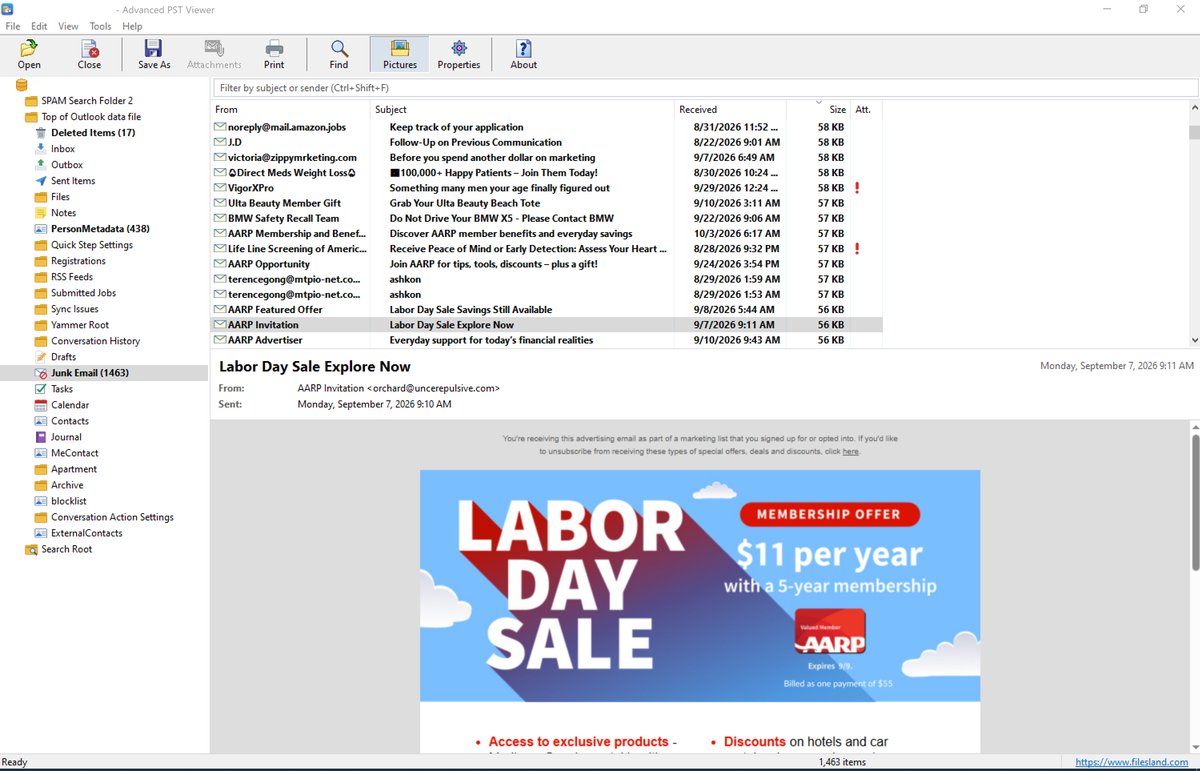
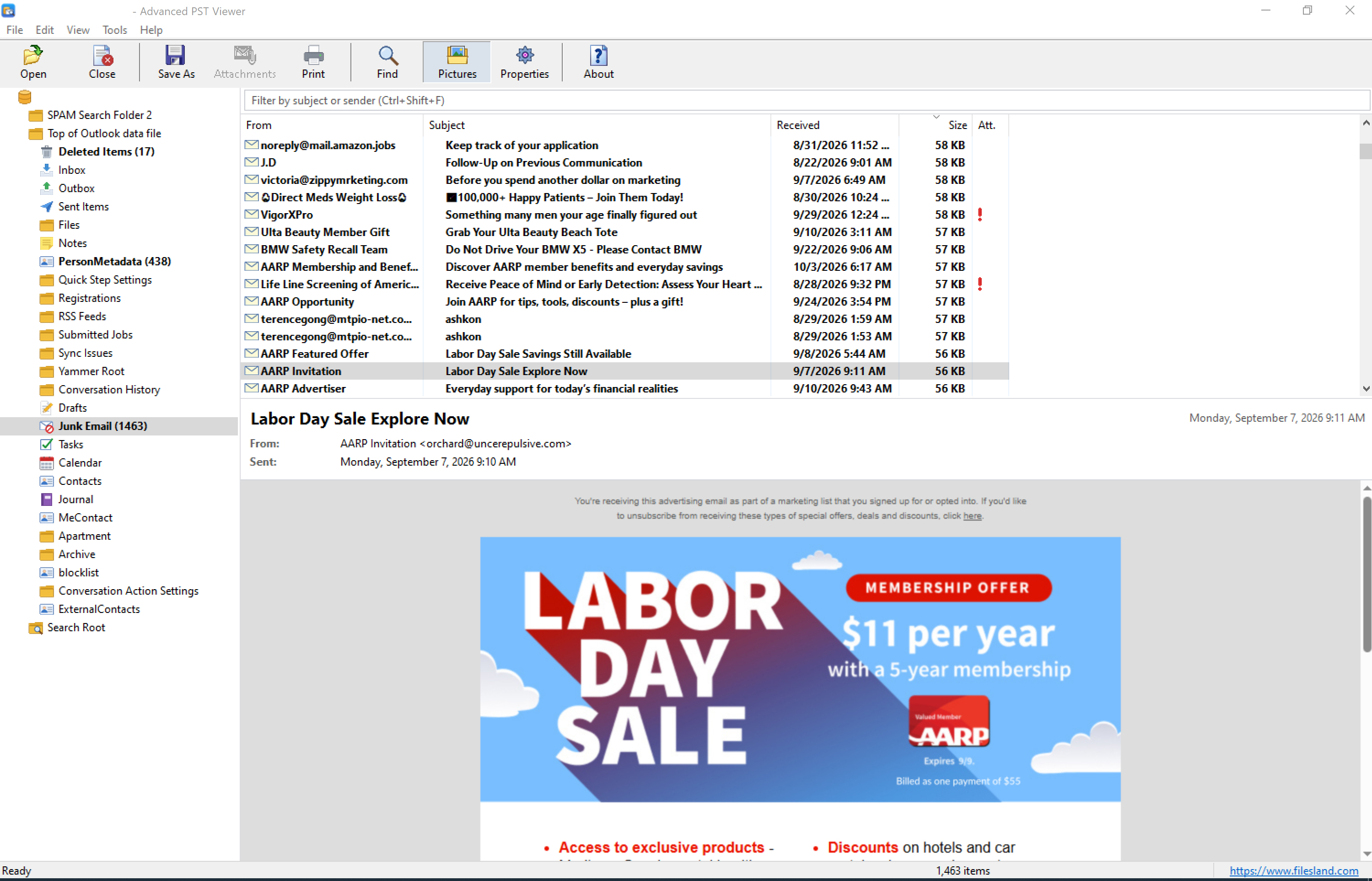
- Familiar three-pane layout: folder tree with unread counts and special folder icons, message list and reading pane.
- Contacts, calendar items, meetings, tasks, notes, journal entries, distribution lists and reports are shown with their own fields.
- Double-click a message to open it in its own window; attached (embedded) messages open in their own window as well.
- Window position, splitters, column widths and sort order are remembered.
Accurate message display
- HTML messages rendered by Microsoft Edge WebView2, with inline images.
- RTF messages converted to HTML (fonts, colors, bold / italic, hyperlinks, pictures); HTML encapsulated in RTF is restored.
- Plain text messages with clickable links.
- Privacy protection: scripts never run, links open in your default browser, and pictures from the Internet (including tracking pixels) are downloaded only when you allow it.
- The real target of a link is shown on hover.
- Print messages with a header block (subject, from, sent, to, cc, attachments).
Attachments
- Open, save and save all attachments of a message (with a warning for executable and other risky file types).
- Extract attachments in bulk from the selected messages, the whole message list or a folder with all its subfolders.
- Filter by file type (for example
*.pdf; *.docx), skip inline pictures, save attached messages as .eml, create a subfolder for each mail folder and add a date prefix to file names.
Save and export
- Save a message as EML (opens in Outlook, Thunderbird, Windows Mail), single-file HTML with embedded images, plain text or PDF.
- Export selected messages, a folder, or a folder with all its subfolders to EML, HTML, TXT, PDF or MBOX (one file per folder, for Thunderbird and Apple Mail).
- Contacts to vCard (.vcf) and calendar items, meetings and tasks to iCalendar (.ics) with recurrence, exceptions, reminders, organizer and attendees — for Outlook, Google Calendar and Apple Calendar. Optionally one combined .vcf / .ics file per folder.
- Recreate the folder structure on disk.
- File name patterns such as
{date}_{from}_{subject}(tokens: date, time, subject, from, to, folder, type, index, id, year, month, day); long names are shortened automatically and duplicates are numbered. - Export the message list to CSV (Excel) for reports and eDiscovery: folder, type, subject, sender, To / Cc / Bcc, sent and received dates, size, importance, read status, flag, categories, attachment count and names, Message-ID and more.
Search and organize
- Find messages by subject, people (sender and recipients, sender only or recipients only), message text or attachment names, in the whole file or in a selected folder.
- Search options: match case, whole words, date range, "with attachments" and message size range; the results show the folder of each message.
- Search hits are highlighted in the message body, subject, From / To / Cc lines and attachment names.
- Quick filter box above the message list (Ctrl+Shift+F) filters by subject or sender as you type.
- Column chooser: From, Subject, Received, Size, Attachment, To, Cc, Sent, Importance, Flag, Categories — drag to reorder; your choice is remembered.
- Sort by any column and group by date (Today, Yesterday, Earlier This Week, Last Week, Earlier This Month, Last Month, Older).
Forensic and technical tools
- Internet headers of a message.
- Message properties: all MAPI properties with names, types and values, including named properties; copy to the clipboard.
- Recover deleted items from the unused space of the file, and show orphan items.
- File information about the open data file.
Main Window
The folder tree of the Outlook data file is on the left, the message list with the quick filter box is on the top right, and the selected message is shown in the reading pane below it.
Advanced PST Viewer Help
Click "Open" on the toolbar (Ctrl+O) and choose an Outlook .pst or .ost file, or drag the file onto the program window. Select a folder in the tree on the left to list its messages, then click a message to read it in the reading pane. Press Enter or double-click to open the message in its own window.
These are the most frequently used commands. You can run them from the toolbar:
| Open | Open an Outlook data file (.pst or .ost). |
| Close | Close the open data file. |
| Save As | Save the selected message as EML, HTML, TXT or PDF. |
| Attachments | Save the attachments of the selected message. |
| Print the selected message. | |
| Find | Search messages by subject, people, message text or attachment names. |
| Pictures | Download pictures from the Internet for HTML messages (blocked by default). |
| Properties | Show all MAPI properties of the selected message. |
| About | Show the program version and registration information. |
Export. Use File > Export Selected Messages (Ctrl+Shift+E) or File > Export Folder to save many messages at once. Choose the format, the destination folder, whether to include subfolders and recreate the folder structure, and the file name pattern. File > Save Selected as PDF and Export Folder as PDF create one PDF file per message. File > Export List to CSV saves the current message list for Excel.
Attachments. Tools > Extract Attachments saves the attachments of the selected messages, the whole list or a folder with its subfolders, optionally filtered by file type.
Search. Edit > Find Messages (Ctrl+E) searches the whole file; Find in Selected Folder searches one folder. Type in the Filter box above the list (Ctrl+Shift+F) to show only messages whose subject or sender contains the text you enter.
Columns. Right-click a column header or use View > Columns to show or hide columns. Click a column header to sort the list; click it again to reverse the order. View > Group by Date groups messages by date.
Technical details. View > Internet Headers (Ctrl+H) shows the original headers, View > Message Properties (Alt+Enter) lists all MAPI properties. Tools > Recover Deleted Items scans the unused space of the file for deleted messages.